
Last June, I wrote about Zohran Mamdani’s win in the New York City mayoral primary and how it felt like a pulse of life for the Democratic party. I didn’t realize how this pulse could be an indication of blood flowing back into the body of a party that has long been dead to the working class. Or, as Jordan Klepper has so eloquently described: “…not only are they alive, they are coked up like Don Jr. at a crypto convention.”
I had originally written this follow-up after Mamdani won the mayoral election, but I kept feeling like there was something missing, and couldn’t bring myself to publish it. But I found that piece walking into the Howard Theatre a few weeks ago, hearing D.C. advocates scream “JLG! JLG! JLG!” at the top of their lungs. I was absolutely ecstatic for this glimpse into a new future. Mayor Muriel Bowser failed D.C., and the country completely, through cooperating with ICE and succumbing to the will of a fascist agenda. But the people continued to organize and won the Democratic primary. I found the missing piece: D.C.’s own Democratic Socialist shift.

Photo Credit: Callie Whicker/The Rival American
That’s the theme these days, and god, I hope it sticks. My hope is that this isn’t just the classic idea of the pendulum swinging back, but a permanent shift. A rejection of the mirage that is the Democratic moderate. A political culture based in humanity rather than depravity.
There have only been a few times I’ve felt truly close to being patriotic in my life. Not in the way that civics textbooks try to teach you, not with red, white and blue fireworks, or waving one of those little flags. The kind where you briefly believe this country might be worth saving. One of those times was standing in Hook Hall, watching Zohran Mamdani win the NYC mayoral election. Another was standing on stage at the Howard Theatre, watching mayoral candidate Janeese Lewis George speak to her supporters on election night in D.C. Even though the race was not called until a few days later, the energy in there was electric, knowing that she would reach victory against her main opponent: Bowser-supported Kenyan McDuffie. The feeling of patriotism doesn’t have to be your classic nationalist American. I think it can be the wave of emotion that comes with community and integrity of a locality coming together and choosing to stand up for themselves.
Most of my political memories have been shaped by despair. I was four when Obama took office, too young to understand the impact of his presidency, but I was old enough to have memories of Donald Trump winning seared into my mind. I grew up with a president who told us that bodily autonomy doesn’t belong to anyone feminine, that the immigrants I grew up around shouldn’t live here and that we should inject ourselves with disinfectants to solve a deadly virus. That was the essence of the political air that I had been breathing on a daily basis.
After living through Trump, Joe Biden winning felt like survival. Biden wasn’t a breath of fresh air for the Democratic Party, but instead a hazy, decaying wind that pulled the American people out of the worst of the miserable storm wrought by Trump’s first term. Many things improved under Biden, don’t get me wrong, but relief is different from belief. The despair still continued: Gaza continued to be mutilated, miniscule climate action was taken, and progress stalled. The feeling that something was deeply broken never fully left; over time, the limits of that relief became impossible to ignore.
Then Kamala Harris ran for president, and I felt there was a chance of something actually new. I poured all of my soul into each and every one of those 107 days in her campaign. Maybe it was as simple as the fact that it wasn’t an old white man running, but there was a movement I could feel, and it felt like a step in the right direction. But then it stalled just as quickly as it had started. The party retreated back towards what was familiar. The week of the Democratic National Convention, I was filled with optimism and joy from just getting to be there. This was my Super Bowl. But then the delegates who were standing up for Palestine weren’t allowed to speak, and I began to feel uneasy.

Photo Credit: Callie Whicker/The Rival American
I didn’t get to stay the last day, and I am so glad that I didn’t. On the plane back to DC from Chicago, I cried hearing Harris say, “I will ensure America always has the strongest, most lethal fighting force in the world.” The prospect faded away, and I sat there, trying to figure out what I had been supporting all this time. In retrospect, I had been backing her out of necessity due to the two-party system, not out of the pride I used to have. But then Trump shortly after, and that fear I had known from my childhood came running back.
Living in D.C. for the past two years has been terrifying. To Trump’s shock, not because of any “rampant crime” or whatever his latest excuse is, but because of his impact all but destroying the will of a city I so dearly love. The National Guard standing in various corners, for “protection,” sometimes carrying guns bigger than my own backpack; going out to celebrate Pride, watching a scuffle break out, and seeing two small girls swarmed by about 10 different federal officers; hearing about people I love in the DMV area being taken away by Immigration Control and Enforcement (ICE) so frequently that it becomes impossible to keep track of who is left.
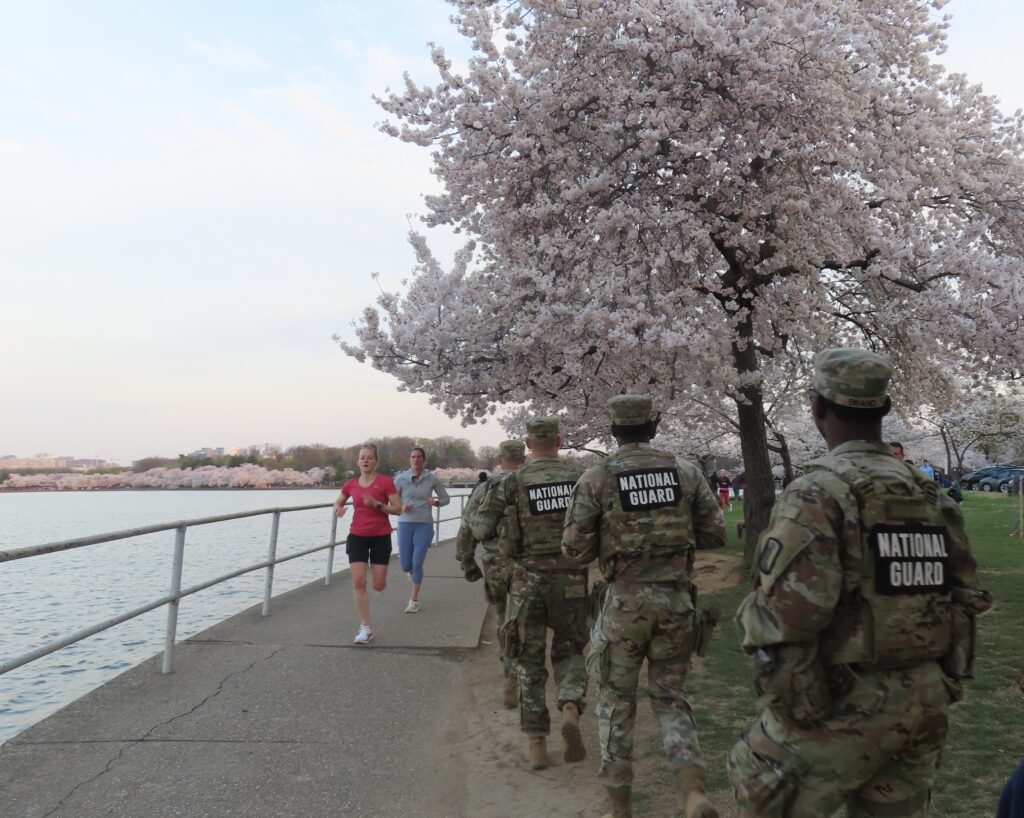
Photo Credit: Callie Whicker/The Rival American
Just in the first month of 2026, there were nine people killed by ICE. According to an independent journal called L.A. Taco with their own personal investigation data, 28 people have died so far in 2026, whether as they state, “in ICE custody, during enforcement actions, in shootings, or after release.” 27 of the 52 that have died since Trump’s second term could have had life-saving medical care but were neglected or received improper care. And those are just deaths. More than 60,000 detainees are being treated like livestock: not being treated for sickness, not receiving needed medications, given strange/insufficient amounts of food, and sleeping on the ground. This includes 6,200 children approximately since Trump’s second term began, being ripped away from their parents by armed agents deployed in the neighborhoods that they’ve always known and loved.
This is not accidental. This is the shape of authoritarianism. This is exactly why Mamdani’s mayorship matters as much as it does. Not because he is a hero, but because he is proof. Proof that people power still works. Proof that grassroots organizing is not dead. Proof that elections are not the theater that so many treat them as.
I’ll be completely honest, the left frustrates me regularly. The ego. The infighting. The way that some use their politics as their entire personality instead of a real responsibility. Too many use radical language as branding instead of action (don’t get me started on “decolonize your mind”), confusing having the “right” opinions with doing the work. Sometimes being a leftist means trying to get people to look up from their screens and pay attention to what is happening in their communities right now. It means knowing that some would rather be correct than effective. That frustration is real, and will probably only grow as more and more candidates with socialist perspectives emerge.
But even with all of its issues, I still choose this side. At its core, leftism is not about sounding smart or being morally superior to others. It is about refusing to accept that suffering is normal. It is about believing that people deserve more than scraps in their lives. It is the now radical idea that human beings should not have to earn the right to live, something that should be fundamental in our everyday lives.
Part of growing up politically, as I have done for my past four years at AU, is learning that politicians are not our saviors and never will be. The hilterns out there will find this shocking, but they are just employees. They work for us, the people. We should absolutely cheer for them when they hit a pitch just right. But we cannot hand them a trophy when they’ve only reached first base. Progress doesn’t stop at the first sign of hope: it is constant work, a constant game that seems never-ending, of true accountability. The job of the people in our political system is not to fall in love with a politician. The job of the people is to make politicians do their jobs, serving we, the people.
Mamdani has accepted that job and has not stopped at rhetoric. At least in my eyes, he has already done more in his term for the people than any other mayor. As of writing this, he has recently delivered on another promise he made in his campaign, freezing the rent in New York City. But again, he knows that his power cannot be taken for granted, and should be continued to be held accountable to the people who gave him his power.
The care that Mamdani has taken should be a message to everyone in politics. His campaign, and work in office, offers the roadmap that the Democratic establishment must replicate if they want to actually stand up to MAGAism. Economic populism that is not watered down into centrist policy. Politics that speak to people’s everyday lives: their rent, their healthcare, their dignity, rather than just serving donors.
On National Coming Out Day last year, Mamdani gave a short profile of activist Sylvia Rivera’s life, filmed at the Christopher Street Pier where Marsha P. Johnson’s body was found after she was killed. Mamdani said in this video: “New York will not sit idly by while trans people are attacked. We’ll deploy hundreds of lawyers to combat Trump’s hate, make New York City an LGBTQIA+ sanctuary city, and create the Office of LGBTQIA+ Affairs to allocate millions for youth and adult housing programs as well as gender-affirming care. We can’t bring Sylvia back. But we can honor her memory by building a city where trans New Yorkers are cherished. In a time of darkness, New York must be the light.”
In a political landscape where Sylvia Rivera’s name is rarely uttered outside queer history classes and protests, seeing her honored not as a footnote but as a political ancestor mattered. This was not rainbow-washing or vague allyship, not just a “love is love” sign. It was a concrete commitment to the trans people of New York City. It shows how, although Democratic politics must be rooted in the day to day lives of people, a politician doesn’t have to give up identity issues either. Both can be true and one doesn’t have to be at the expense of the other, as seen by Abdul El-Sayed.

Photo Credit: Julia Demaree Nikhinson at The Associated Press
As of concluding this piece, progressive populist El-Sayed just won the Senate primary in Michigan, defeating almost $32 million dollars in AIPAC funding. That’s the most funding spent in this cycle so far, solely for ads against El-Sayed. The progressive, although not a self-described democratic socialist, has many of the same values, including ending the genocide in Palestine, Medicare for All, getting rid of corporate money in politics, reforming the Supreme Court, abolishing the Senate filibuster, and raising taxes on the wealthy (focused on millionaires and billionaires specifically). Many of these positions are in-line with those of Mamdani and the DSA, and were able to edge out victory in a deep purple swing state, despite the tens of millions of dollars that went into bad-faith campaigning against him. In this, the left has been able to prove a malconceived popular claim by adversaries across the political spectrum, that progressive and socialist agendas can only win over voters in blue strongholds, dead wrong: there is an appetite for change across the country.
Mamdani was right that New York has become a light, but it’s more of a star. It’s a bright star now, with Mamdani at the forefront. I hate that people are referring to him as “Kingmaker,” though. He was just the first this decade to gain national attention and organize a campaign so strong, so rooted in people power that it was impossible for it not to deliver. And while he was the first, he is now far from the only: Janeese Lewis George in DC. Brad Lander in NY-10. Claire Valdez in NY-7. Darializa Avila Chevalier in NY-13. Abdul El-Sayed in the Michigan Senate. All except Lander and El-Sayed ran with the backing of DSA, and all of the New York candidates received Mamdani’s endorsement. This leftward trend extends further than the Northeast Corridor; in the state houses of Georgia and North Carolina, DSA-backed and preferred candidates have won their elections, too. It goes to show that people-rooted politics are paths to winning, no matter the area.
I think it really did have to get dark enough to see the stars. With this clearing sky full of stars, I hope that we see a supernova across the country soon.

Leave a Reply