
In just a few short days, our proud and tired nation will be blowing out 250 candles. The U.S. will cut the cake for its Semiquincentennial, a word that is as real as it sounds fake. It works well as the title for this series, which will be as real as it feels fake. Inside DC, a raucous celebration is going to be underway all summer long, planned and executed by a coalition of presidential officials, gambling promoters, and museum curators. The series will try to soak up as much of this bizarre exercise in patriotism and nostalgia, and then wring it out for students missing DC, residents too proud to attend Trump’s vision of a 250 celebration, and peers who read the Rival out of courtesy.
This work needed me to set rules for myself. First, this is not a protest. Every event might have its share of passionate people demonstrating against the injustice and chauvinism of DC’s 250 celebration. I commend and sympathize with them, but my goal is to see how this unfolds from inside the gates, not from in front of disaffected National Guards pretending they don’t see me. Second, everything written will be true. Third, nothing will be objective. Finally, seeing what 250 years celebrated here looks like means an open mind. Given the opportunity, I won’t say “no” to any festivities or opportunities if I have any option to. But I will respect “no” from the UFC, who denied giving me a press pass to the White House lawn fight weeks ago. This first installment is a test flight of sorts. If I’m going to be able to brave what’s being called “The Great American State Fair,” I ought to explore state fairs in a contained, air conditioned setting with less of a police presence. For this, I traveled downtown to explore a small Smithsonian’s tribute to homespun state fairs from across American history. I got off to a rough start.
State Fairs: Growing American Craft at the Renwick Gallery
I started off the 250th anniversary like any trip I make in DC during the summer, refilling my SmarTrip from total bankruptcy all the way up to the bare minimum I need to get there and back on the Metro. Exiting on K Street, I encountered a busy Farragut Square dotted with white plastic chairs radiating in the late afternoon sun. Many of these chairs across the green were occupied, but all of the occupants sat hunched over aggressively as one could without spilling out of the chairs. They all used their own flesh to shield their phones from the sun, casting their own shadow to alleviate the demand on their screens’ brightness. Meanwhile, on a small platform a man and a young woman performing blues music hollered into their mics, bantering with the oblivious crowd seated in chairs belonging to whatever promotional event they were supposed to be performing for. The only figures in the square who seemed to have any awareness, let alone any appreciation of the live music were the small contingent of National Guardsmen, watching the performance as they dutifully marched on their patrol from Farragut North to Farragut West and back.
I kept on towards the Renwick, and even on a pleasant day that didn’t poke above 80 degrees, I began already regretting this job for when the real DC summer weather kicks in. I still chose to unnecessarily cross the street to walk in the shade. I noticed a man wearing the same button down shirt I own, and I took comfort that his linen had ungovernable wrinkles that were equally impossible to iron out. I tried dodging a very friendly group of street canvassers, and as justice I almost got myself run over by a man resembling Jay Pritchett of Modern Family on his bike. I walked past the Potbelly’s sandwich shop on Pennsylvania Avenue, which I remembered last eating in after a long day on my feet in the Women’s March in January of 2025. Those of us who were in DC remember that last protest coinciding with the week of Trump’s inauguration. I recalled waiting for a meatball hoagie in a packed line, split evenly between protesters and obvious visitors for Trump’s second inauguration. They were braving the mild DC cold to see their president crowned, before the event was ultimately moved indoors in favor of a small ceremony with just family, friends, and Silicon Valley. If the protesters weren’t exhaustedly filled with bitterness and apathy, and were the inauguration tourists not all geriatric retirees possessed by Facebook, it’d have made for the stuff of a good saloon brawl.
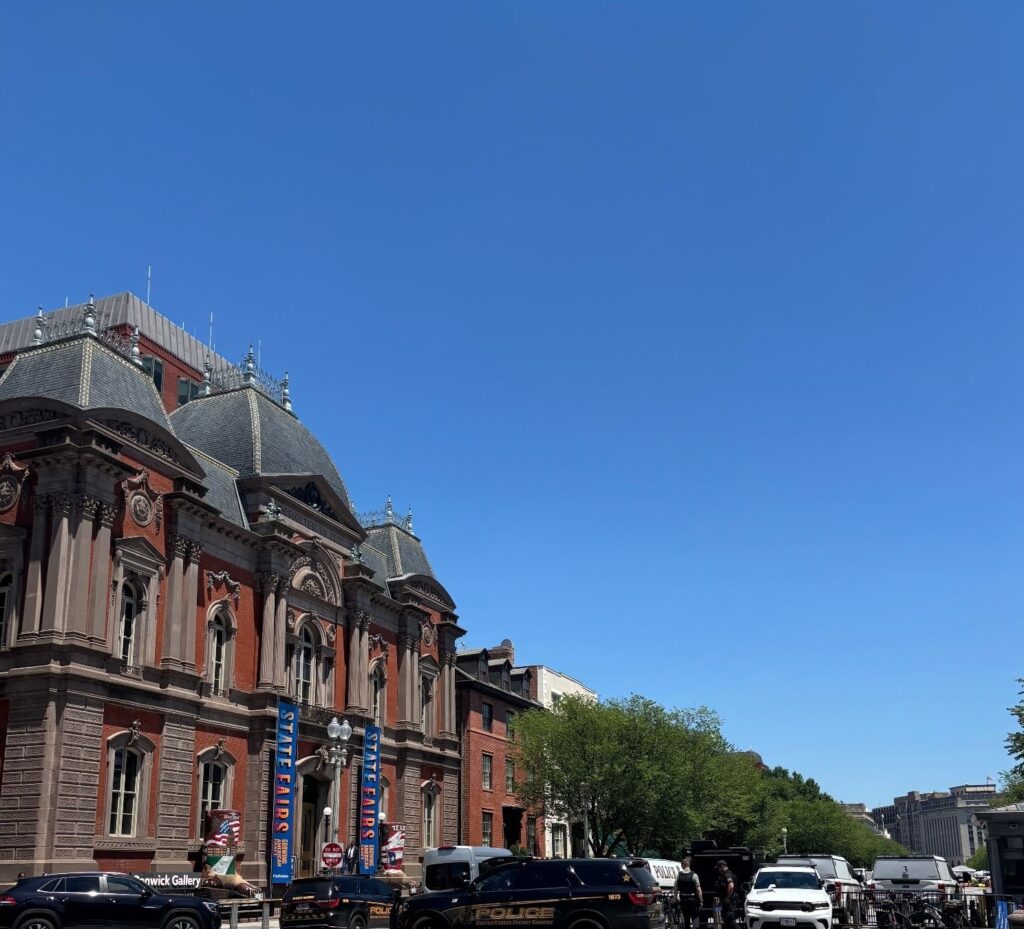
When I reached the Renwick Gallery, I realized I had stumbled into a crime scene. By that, I mean the mouth of the crosswalk leading to the gallery was very literally cordoned off by yellow police tape. Across the street, the opposite road was barricaded by a fleet of Secret Service vehicles large enough to protect a cabinet official, maybe even a vice president. In the center, an empty grey SUV stood idle with all its doors and flaps opened like a virile peacock. Glass from the rear window was scattered across the pavement, while Secret Service agents overdressed for downtown Fallujah examined it. Lord knows what had happened. I wasn’t interested in finding that out, but I still wanted to make my way to the State Fair exhibit. When I, along with other brave souls, tried to cross the invisible barrier on the crosswalk, an agent buffer than he was tall began flailing his tattooed arms frantically, communicating very clearly that we were not going to be able to learn about state fairs today, or go anywhere near that side of the street unless we wanted to experience what happened to whoever had been driving that SUV. As I retreated past the side of the Renwick, I spotted the ushers from the museum standing at their posts by the front door of the building, oblivious and chatty. They seemed unbothered that Olympus had fallen right in front of them. I decided to explore our state fairs another day.
TBD/10
Shakespeare and the American Story at the Folger Shakespeare Library
Licking my wounds, I chose to hit another easy 250th anniversary event on the list for this series. In celebration of the anniversary, Folger Shakespeare Library has an exhibition that claims to demonstrate how impactful the Bard of Avon is on American history, in spite of his Englishness. I boarded a quick blue line to Capitol Hill, riding the escalator behind the same squad of melophile National Guards who I encountered earlier. Over their camo capped heads, the speaker system in the station announced delays on parts of the line due to a trespasser being struck at Pentagon City. I wondered if they couldn’t have called the poor guy something nicer than “trespasser” since he’d already bore the brunt of a train. Onboard the Metro, I realized looking out the window at one of the stops that I need to thank a little blonde boy on the platform standing with his arms outstretched in front of him, who appeared to be using the force to move my train and open its doors. It is a well kept secret that DC’s public transportation relies on the tireless work of Jedi child laborers.
I legged it past the Capitol in search of Shakespeare and a path with shade. A man with a speaker chained to the shoulder of his backpack and obviously wearing a pair of Meta glasses marched broodingly back and forth in front of the Capitol Police, loudly playing “Rock the Casbah” for some sort of ritualistic one-man protest. The cops seemed uneasy about the bizarre display, as he was likely angered that there was no longer any money in it for him to raid the place. Approaching the basement of the Folger Library, its rolling waterfall fountain reminded me that I needed to find a bubbler and drink up. I refused to blow money waiting in line behind summer camp field trippers for bottled water.
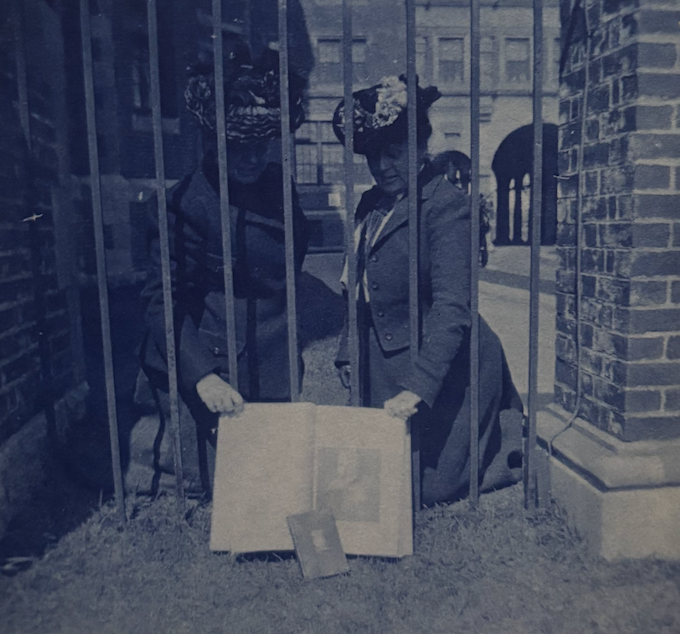
The library was tucked underneath the coffee mogul’s theater, made up of a dim maze of cherrywood hallways. The exhibition itself wasn’t too small. It did its work to highlight the first Americans to meet its self-assigned Shakespeare milestones. First published, first translated, first edition edited by American women. For that one, I learned that the editors Charlotte Porter and Helen A. Clarke posed for a photo in 1903 holding their work through the holes in a metal gate. Clever. One of the panels described how early American editors used Shakespeare to support the identity of Americans reliant on “enslaved agricultural labor,” a wording so technical and so laundered that I truly cannot tell if it was a well-meaning, progressive attempt at humane language, or a Trump mandated self-censorship. It was followed by a publication in a display case, the first collection of Shakespeare’s works promoted in the US in 1844. Its cover had a pleasant sketch of a Native American man in a canoe being brought civility and art by none other than a superhuman Shakespeare himself.
A panel on the outer wall detailed the museum’s origins. As it turns out, Henry and Emily Folger each studied Shakespeare in college during the 1800s, before Henry became chairman of Standard Oil. I found great joy that Henry Folger belongs to a longstanding tradition of liberal arts students who go on to work at the Standard Oil’s of their times. I may even buy his coffee. The rest of the exhibit detailed how Shakespeare was immediately used in the US to market products, including a sewing machine company that published brief summaries of his works to advertise how much faster their product sewed. The best gimmick, however, was a publication of George Washington’s farewell address printed and sold in Massachusetts that opened with an entirely fabricated quote from Shakespeare. The title page read “‘It is a Legacy worthy such a Father’ – William Shakespeare.” The museum claimed the quote sounded weighty enough for no one in Massachusetts to bat an eye. Nearby, I overheard a woman tell her husband, with deep admiration, that “back then, all they really had was the Bible and Shakespeare.” Another artifact celebrating Shakespeare’s touch on our history was a letter from Revolutionary War commander Charles Lee addressed to the Continental Congress in 1776. In it, General Lee (not that one) quoted Richard III (that one) to complain about his circumstances. The excerpt is bookended by his complaints that the British have a superior “number of slaves,” and that the ones in Carolina might revolt, and also a request for more kegs of beer. Regardless, I was more struck by an earlier quote where Lee wrote “I am like a dog in dancing school.” The image of Air Bud in a ballroom struggling meets, maybe even exceeds, some of Shakespeare’s weaker works.
I left the Shakespeare 250 exhibit, but I decided to glance through the rest of the library. This was a good decision, as it included a fascinating display about Ira Alridge, an African-American actor who was America’s first famous Shakespearean performer. Ahead of his time with his understanding of show business, Alridge would bill himself as “African Roscius” as a stage name, before dying unexpectedly on tour in Poland, where theater goes to die. Unfortunately the museum did not mention America’s other great Shakespearean actor, Harold Perrineau as Mercutio in Baz Luhrmann’s 1996 Romeo + Juliet. I hiked back to Union Station. On the way, I tipped my cap at the office of the Heritage Foundation, the only DC team to win a championship this decade. A few blocks away from the Metro, I walked past a large man in a patch of grass laying belly up facing towards the sun. His gut was unsheathed from his shirt, with one leg awkwardly propped up on a red mobility scooter. He hummed to a song with his eyes closed and glowed in the sunshine. He declined to confirm whether or not he was comfortable in that position when I asked him.
5/10
State Fairs: The Return
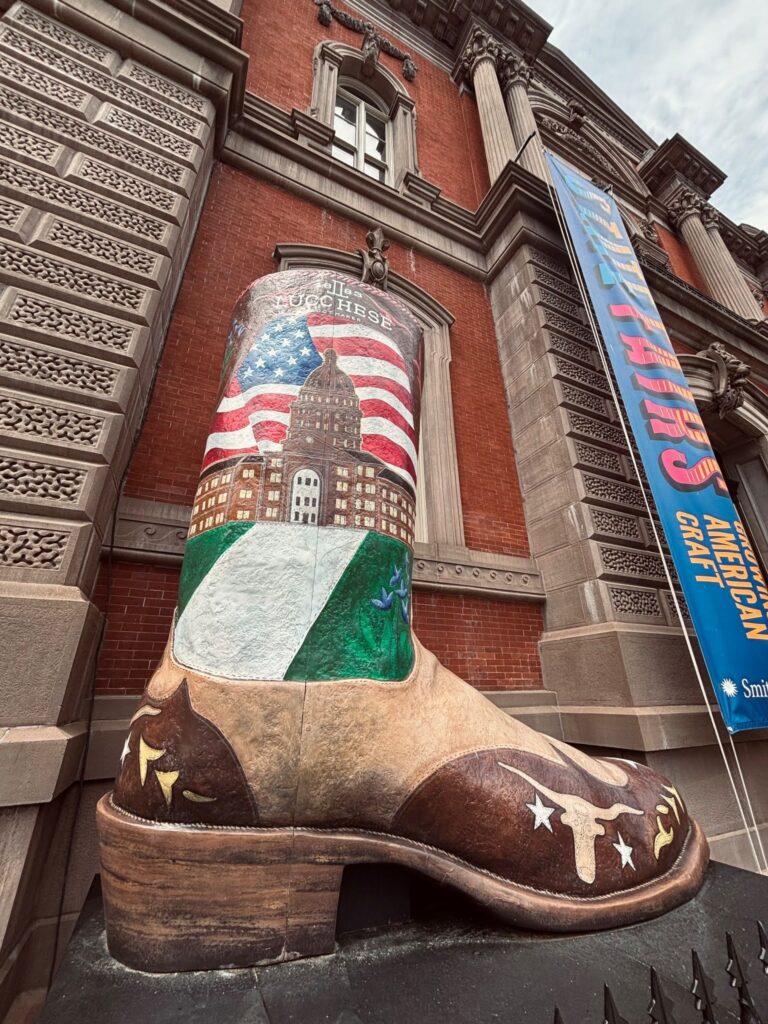
This day’s trip wasn’t as eventful. My hat was knocked off by a low-hanging street sign I forgot to duck. The DC weather did its favorite magic trick. What started as a serene 90 degree day when I entered the Metro became something so grey and so muggy, that when I came back out it was like being transported to London put in an air fryer. Against the brick building, I spotted something I had completely missed in my first trip’s commotion. It was like a Where’s Waldo hidden on the LA freeway during the OJ chase. There was a massive cowboy boot, at least my height. No, well above my height. It belonged to Big Tex, the 55 foot mascot of the Texas State Fair. He’d generously amputated his foot to honor this country’s birthday. I was awestruck.
The inside of the gallery greets you with an enormous neon sign, covered in hundreds of dancing bulbs, that looked like it had been carefully stolen from the Vegas strip by Danny Ocean’s crew. It read “HOWDY FOLKS” in thick yellow letters, and the red and blue bulbs turned the ornate gallery into a more ethereal environment than the staff were used to. I couldn’t help but notice the anxiousness in the steps of the ushers and security. It was lost on me then that I had been there with them the day before when a Kia brought Pennsylvania Avenue into disarray.
Items in the exhibit were more eclectic than even my coastal imagination could’ve expected for state fairs. A lifelike sculpture of dozens of corn dogs protruding from a china vase filled my mind with lustful thoughts of lunch. It shimmered like it had been deep fried in diamonds. A passionately detailed tapestry depicted, among other things, the Japanese attack on Pearl Harbor. Intricate wood carvings drew you in with illustrations of Native Americans that would make Cormac McCarthy shudder. A quilt hung on the wall, made up of countless prize ribbons from other quilts at other state fairs. The young woman near me scoffed at the lack of humility from the creator.
I realized soon after that on the inside many of these pieces, it contained an artist’s enormous love for little mundaneities and the small items we share, and also that this was gently thawing my cold, callous northeastern heart. I think it was a model of sugar and coffee creamer that tapped that well inside of me. But then came a dress from Minnesota constructed from butter packages. Land O’ Lakes, Clarrissa, Blue Ribbon, Goodhue, and dozens of other brands assembled neatly into a spectacular composition. Were Paul Thomas Anderson there with me, he would have regretted making a film about British haute couture instead of the humble Minnesotans behind this work. The plaque read that this dress was an antique, as most of the brands whose packaging was used were consolidated within a decade of the dress’ debut at a state fair.
The butter dress was the last item I encountered before the gallery became something far more uncanny, something in its atmosphere that felt uneasy at best and sinister at worst. Actually, before that I did enjoy a collection of celebrity portraits made from seeds, nuts, and tree needles. Some presidents’ depictions were lackluster, but there was a superb Willie Nelson portrait, which, no, was not made from what we would expect. I took a moment before taking the marble staircase up to the second floor of this sprawling collection, which was filled with work from fairs in western states. I reflected and realized most of what I knew about “out West” came from a mix of books, Ralph Lauren ads, and Pee-wee’s Big Adventure. The gift shop radio was playing “Tequila” as a sign that it could read my thoughts.
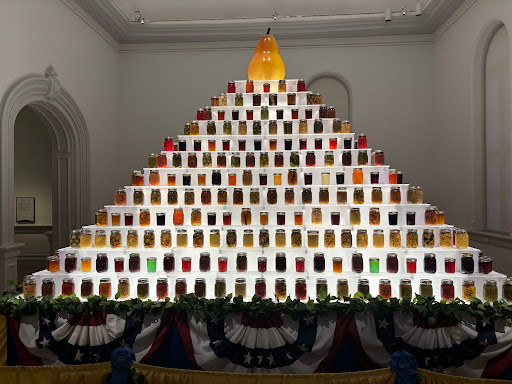
Upstairs, I met a creature that I’d heard plenty about but hadn’t seen in the wild: the illustrious butter cow. In contrast to its spotless refrigerated containment chamber, seeing this beast made me feel uneasy and unclean. It was something uncanny. There was something almost morbid about it, and its sanitary display made it feel occult. I felt like Moses would come storming down Mount Sinai at any second and scorn me for worshipping this dairy idol. Maybe I didn’t worship it, but the other viewers certainly adored it. I got distracted by the sight of a see-through walk-in freezer. Any one who’s worked a day in food service would resent a windowed freezer, afraid of a muckraking Upton Sinclair learning about blinkers. Things only got more uncanny. Home canning was celebrated by a 20 foot Aztec pyramid of canned fruits lit like a Macy’s perfume display and adorned in patriotic bunting, with an enormous pear on top. After this I drifted into what seemed like an abandoned aircraft hangar decorated for an old money Mardi Gras ball. A poorly lit, furniture-less room filled itself with purple streamers, fake ballroom decorations, and the echoes of two security guards who used this visual art project as a makeshift break room. I felt like I’d come in as the janitor for the morning after a great party hosted by despicably rich people. It finally unnerved me enough that I knew I’d had enough of a warm up to state fairs for the day. Rootin and tootin.
7/10
After a long week, I had gone out for a drink at one of many DC bars enjoyed by AU students and NW residents alike. I thought about my awe at my two trips to see a state fair exhibit once. It gave my hopes a high ceiling for the extra special state fair being built on the National Mall. But even rummaging through a museum for a weird little warm up to this series told me I was getting in over my head. Much of DC feels like it was meant to explore America the same way I just had done. Residents looked at the great interior of the country from the opposite side of Smithsonian glass and read about it from a small plaque with tiny sans-serif fonts. No one was thrilled to have it descend on the National Mall for a few weeks, set up camp, and enjoy a plastic jamboree spewed out by the President and his loyal contractors. While the Great American State Fair opened up only a few blocks away, it got a cold shoulder from the locals who just wanted to take a photo of a quaint butter cow and try seancing Shaksepeare’s opinion of America. This 250th summer would be celebrations split like oil and water inside of the city. I’d dipped my toe in. Sitting by my drink and notebook, I knew in a few days I’d need to pencil dive into the algae blooming deep end of the other side. The unique part of sitting at a bar, whether it be a veritable dive or a diner counter to eat latkes, is that in order for the experience to be enjoyable you often have to feign partial blindness in one or both eyes. Unless you’re the lucky one sitting wedged between two friends, you need to do to yourself what is done to an anxious horse in order for the whole thing to work. This night on my right, a woman with her husband complained to me and the bartender about how different the spot is when there are AU students, and how much better it had gotten since they’d all left. I told her I wholeheartedly agreed.
“Giveth man a city for scholars and for despots, thou must nameth thee Washington.”
– William Shakespeare
Leave a Reply